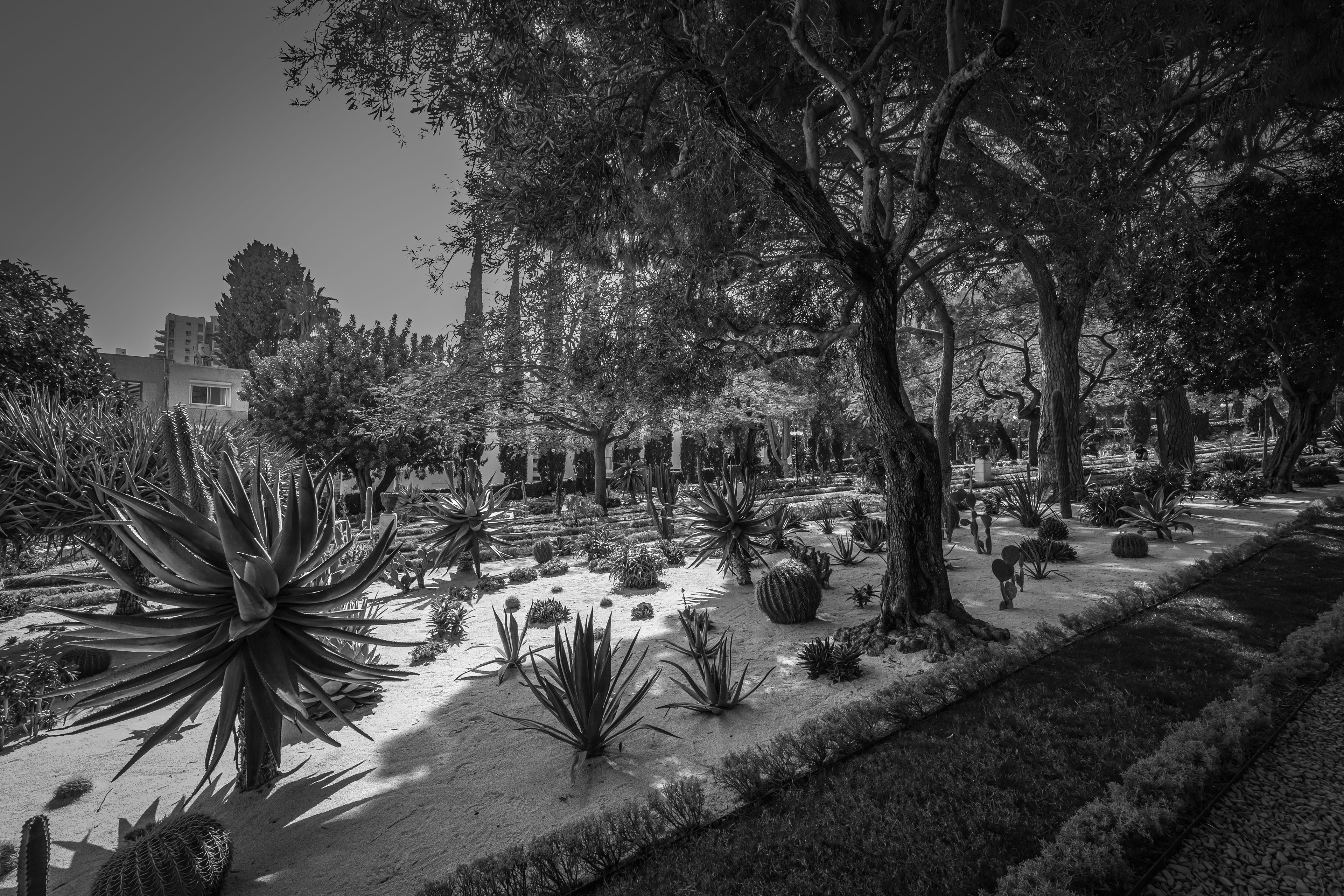
Black and white landscape photography always feels like a decision rather than a default, almost a small declaration that you’re willing to give something up in order to gain something else. Looking at these two frames, both rooted in the same garden environment yet breathing very differently, it becomes obvious why monochrome still matters. The first scene, dense with succulents, cacti, and twisting trees, turns into a study of structure once color is removed. The sharp geometry of agave leaves pushes outward like frozen explosions, while round cacti sit low and heavy, anchoring the sandy ground. Light slices across the scene in uneven patches, brightening the sand and leaving the foliage in layered greys, from soft silvery highlights to almost ink-black shadows under the trees. Without green or blue to guide the eye, the photograph becomes about rhythm: spines against smooth sand, thick trunks against thin leaves, chaos held together by light. It’s the kind of image where you notice how sunlight actually moves through space, not how it paints it.
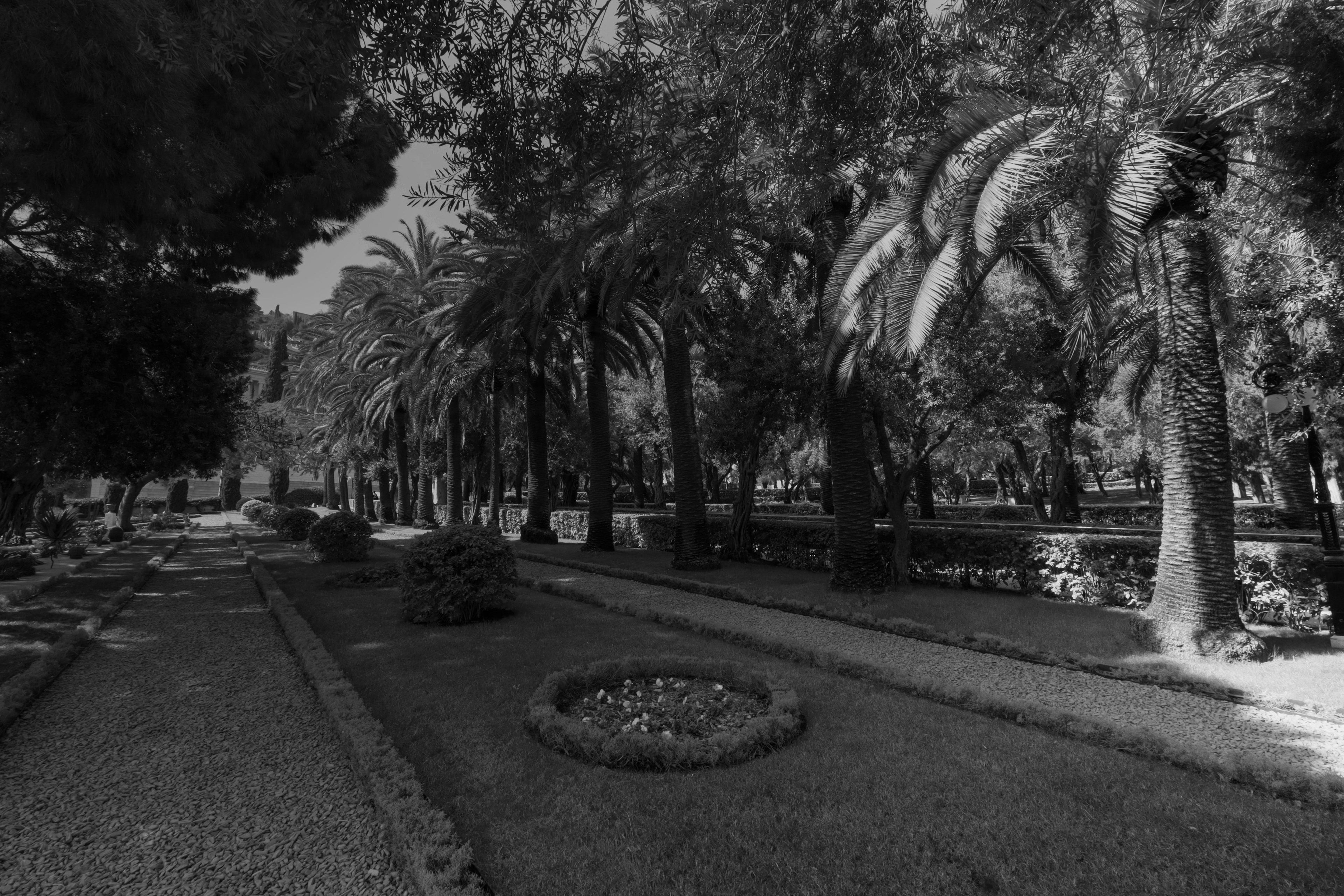
The second photograph shifts mood entirely. A long palm-lined avenue stretches forward with a calm, almost ceremonial symmetry. The gravel path, pale and textured, leads the eye straight ahead, flanked by manicured grass and repeating tree trunks that feel steady and deliberate. Here black and white amplifies order rather than tension. The palm fronds glow where the sun hits them, each leaf catching light like brushed metal, while the shaded areas fall into deep, quiet tones that slow everything down. In color, this might feel lush or even postcard-pretty; stripped to monochrome, it becomes timeless, closer to memory than documentation. You’re not thinking about season or temperature or even location as much as you’re thinking about pace, about walking slowly down that path and letting the repetition carry you forward.
This is often the real reason to choose black and white landscapes: when color starts to distract from what you actually want to say. When the story is about form, contrast, light direction, or emotional weight, color can be a bit too talkative. Monochrome forces the photograph to speak more quietly and, oddly enough, more clearly. It works especially well in scenes with strong midday light, like these, where harsh sun can flatten colors but carve beautiful shapes. It also shines in places that feel layered with time, gardens, parks, old paths, anywhere that already holds a sense of continuity. Black and white doesn’t make a landscape more dramatic by default, but it does make it more honest about what’s holding the frame together.
Choosing black and white, then, is less about nostalgia and more about intent. It’s about knowing when the bones of a scene are strong enough to stand on their own. In these images, the absence of color doesn’t feel like loss; it feels like focus. You’re left with light, shadow, and form doing all the work, and sometimes that’s exactly the point.