Covering Tech Events Through a Camera Lens
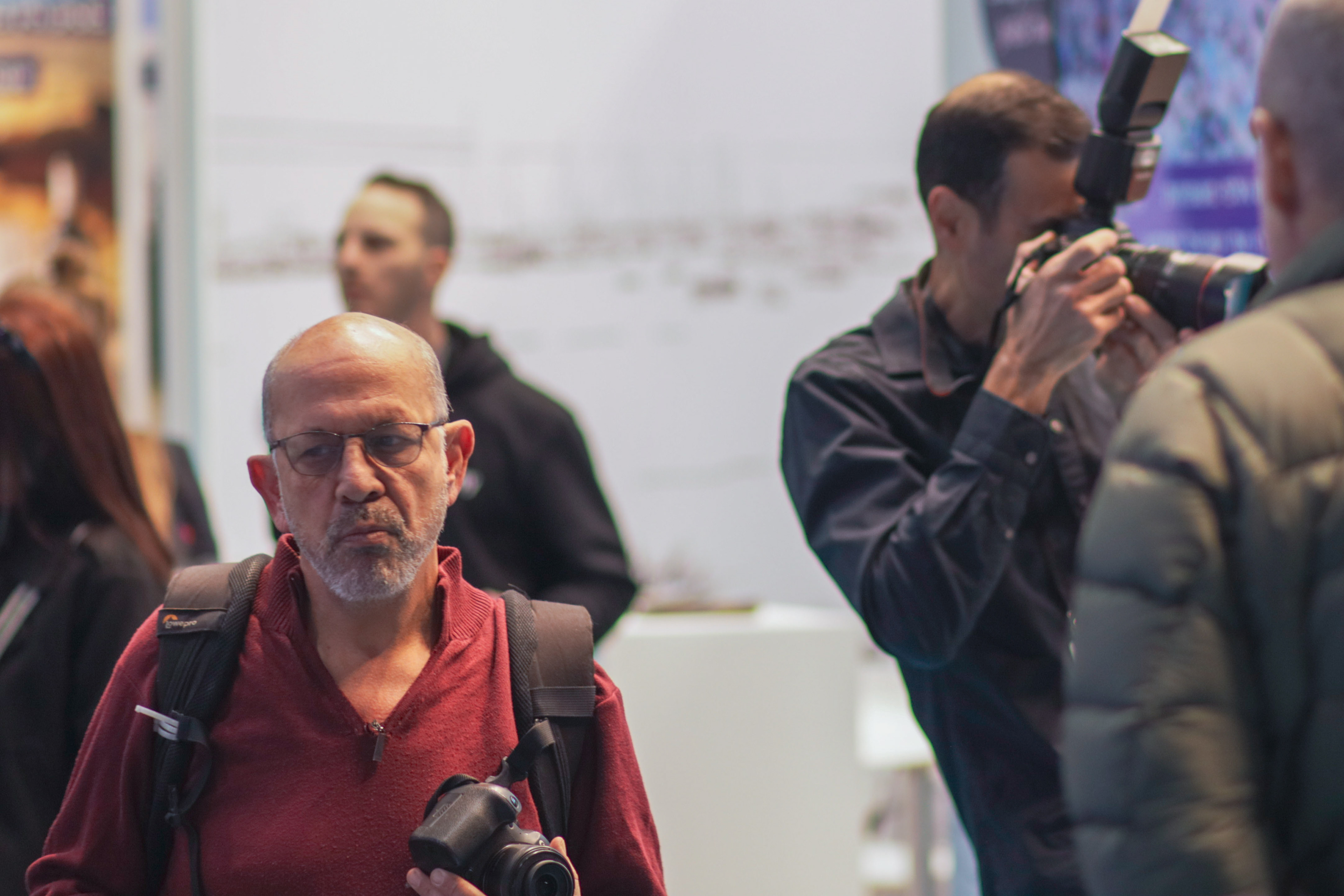
The photograph captures a quiet, telling moment inside a busy tech or exhibition environment, where attention is split between watching and documenting. In the foreground, an older man stands slightly off-center, facing forward but not quite engaging with the camera. He wears a deep red zip-up sweater, the color muted but warm against the otherwise cool, softly lit background. A backpack rests on his shoulders, straps visible and worn-in, and in his hands he holds a camera almost absentmindedly, as if he has just lowered it after taking a shot or is waiting for something worth raising it again. His expression is serious, inward-looking, maybe even a bit tired, the kind of face that suggests long hours on his feet, scanning scenes, deciding what’s worth capturing and what isn’t. Thin-framed glasses sit low on his nose, catching a hint of reflected light, while his closely trimmed gray beard adds to the sense of experience, of someone who has been doing this for years.
Behind him, slightly to the right, the scene becomes more kinetic. Another photographer is actively shooting, camera pressed to his face, a large external flash mounted on top, angled upward. His posture is focused and intent, shoulders slightly hunched forward, elbows tucked in, fully absorbed in the act of photographing someone just outside the frame. You can almost hear the click of the shutter, the brief pop of light that’s about to follow. The contrast between these two figures is striking: one paused, observing, and the other fully in motion, mid-action. Around them, blurred figures move through the space, suggesting a crowd without overwhelming the image. Jackets, backpacks, and neutral tones hint at an indoor event where people circulate constantly, stopping briefly, then flowing on again.
The background is softly out of focus, dominated by pale panels and indistinct signage, likely exhibition booths or presentation screens. This blur helps isolate the photographers as subjects themselves, turning the camera back on those who usually stand behind it. The lighting is even and diffused, typical of conference halls, flattening harsh shadows but giving the image a calm, almost subdued atmosphere despite the implied noise and activity. What makes the photo compelling is this sense of in-betweenness: it’s not about the technology on display, nor the official moments of the event, but about the people documenting it, caught between shots, between attention and rest. It feels observational and honest, a small slice of what it actually looks like to cover an event from inside the crowd, where photographers become just another layer in the visual ecosystem they’re trying to capture.
Tech events have their own visual language, and once you start paying attention to it, you can’t unsee it. The light is almost always artificial and slightly unforgiving, bouncing off polished floors, LED walls, and glossy demo units, but that’s part of the challenge. Walking into a conference hall feels a bit like stepping onto a film set mid-shoot: cables taped to the ground, people half-lit by screens, faces flickering between attention and distraction. As a photographer, you’re constantly negotiating between the scale of the event and the small human moments hiding inside it, the quiet focus of someone listening intently, the nervous energy at a startup booth, the split second before applause breaks.
What I enjoy most is drifting away from the obvious hero shots. Keynotes matter, sure, but the real story often lives just off-stage. A founder rehearsing a pitch one last time, a tired engineer leaning against a pillar scrolling through notes, a cluster of attendees framing the same robot demo from five different angles, phones raised like a strange modern ritual. These scenes say more about the state of technology than any slide deck ever could. You start noticing patterns too: the way people gather around AI demos with a mix of curiosity and suspicion, how hardware booths invite touch while software booths rely on spectacle, how networking areas slowly empty as the day wears on and conversations become more honest.
Photographing tech events is also about embracing imperfection. Motion blur from animated hand gestures, blown highlights from massive screens, awkward compositions where branding almost overwhelms the subject. I’ve learned not to fight these things too hard. They’re part of the environment, part of what it actually feels like to be there. A perfectly clean image can sometimes lie; a slightly messy one often tells the truth. The goal isn’t to make technology look flawless, but to show how people interact with it in real space, under real lights, with real fatigue setting in by late afternoon.
By the time I leave, usually with aching feet and far too many frames on the card, I feel like I’ve collected fragments of a larger narrative. Not just what was launched or announced, but how it landed visually and emotionally. That’s what I want this photoblog to capture over time: tech events as lived experiences, not press releases. Screens, faces, gestures, moments of wonder and moments of doubt, all stitched together through the camera. It’s less about documenting innovation and more about observing how innovation looks when it steps out of the lab and into a crowded hall, surrounded by people trying to make sense of it, one conversation and one photograph at a time.
Upcoming Tech Events