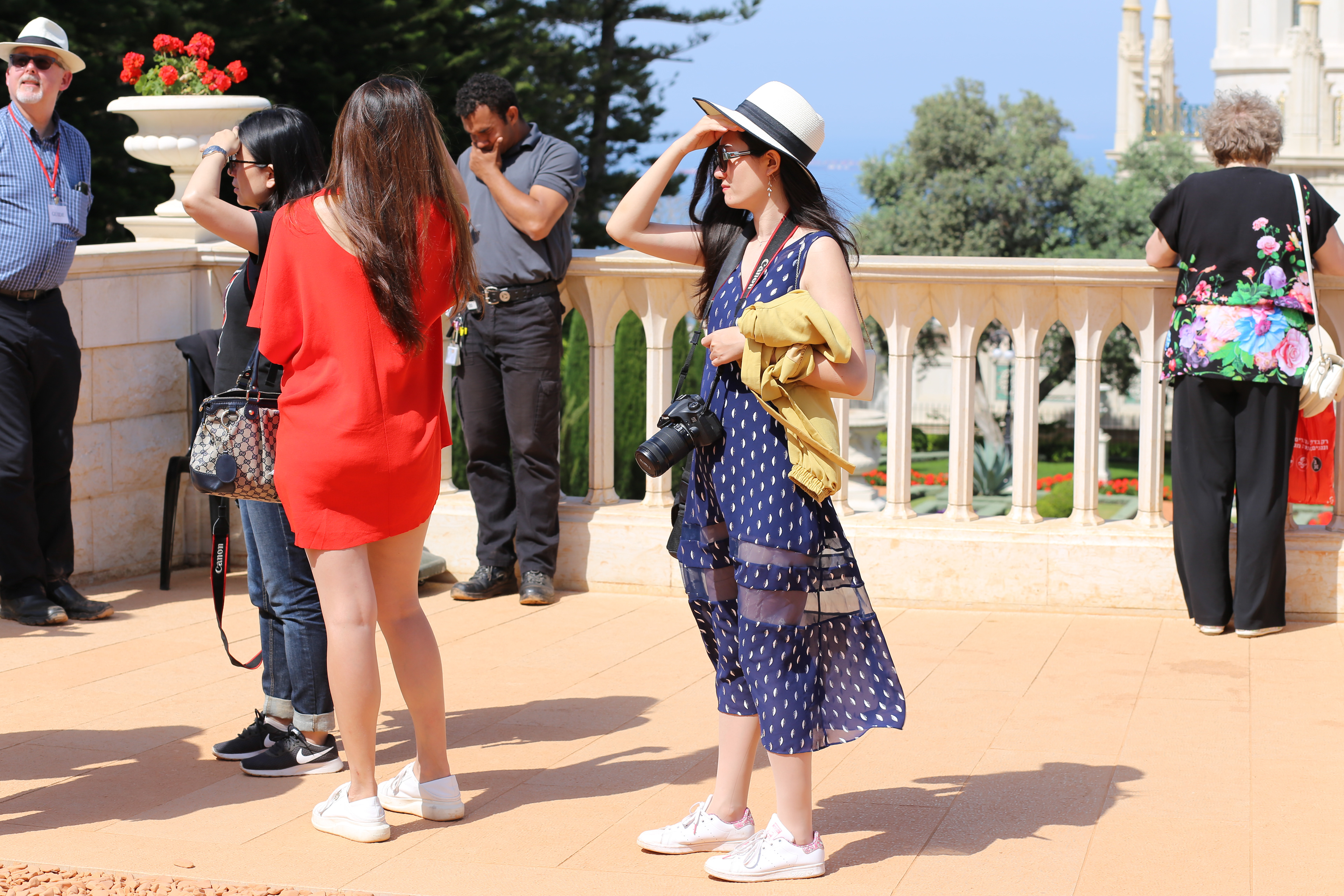
The first thing that hits me in this image is not the architecture or the view beyond the balustrade, but the posture of the people. Everyone is doing something slightly different, slightly private, even though they’re standing in the same sunlit space. In the center, a woman in a navy blue dress dotted with small white shapes pauses mid-step, one hand shielding her eyes from the light, the other holding a camera that hangs almost casually, like an accessory rather than a mission. She’s dressed for the moment rather than the destination: white sneakers dusty from walking, a light hat pulled down just enough to suggest she’s used to this sun, a folded jacket draped over her arm because travel days are always about temperature guesses. Around her, other tourists are busy with their own rituals — one checking a phone, another turning her back to the view, someone else leaning on the railing as if the landscape were secondary to the pause itself. Even the security guard in the background seems lost in thought, head down, momentarily disengaged from the scene he’s meant to oversee. The place is clearly beautiful, classical, curated, but the photograph isn’t about that. It’s about how people now occupy beauty differently.
Travel photography used to be about proof. You went, you saw, you captured. The camera was pointed outward, toward landmarks, vistas, monuments, sunsets lined up with guidebook promises. Now, the camera often points sideways, or downward, or waits. It records hesitation, adjustment, shade, boredom, light too strong at the wrong hour, the micro-moments between “taking a photo” and “being there.” In this frame, the photographer is almost invisible, despite the camera being in plain sight. That’s the shift: the act of photographing has become softer, less declarative. Cameras are worn, not wielded. They hang, they rest, they wait for something unplanned. The image itself feels like a byproduct of presence rather than the goal of the trip, and that’s a big change, even if nobody says it out loud.
What’s also changing is the hierarchy of subjects. The landscape is there, but it’s filtered through people adjusting themselves to it. The architecture becomes background texture, the flowers become color accents, the sky a simple wash of blue. The real story sits in the body language — shielding eyes, shifting weight, turning away, holding devices, holding nothing at all. Travel photography is no longer obsessed with “where,” but increasingly with “how it felt to be there for a minute.” This image doesn’t sell a destination; it documents a pause, a collective exhale under bright sun, a small human choreography that happens at every famous place now, whether in Italy, Israel, or anywhere else that attracts cameras and expectations. And honestly, that’s what makes it more honest. The world hasn’t become less photogenic. We’ve just stopped pretending we’re always looking at it the same way.
Related
Related