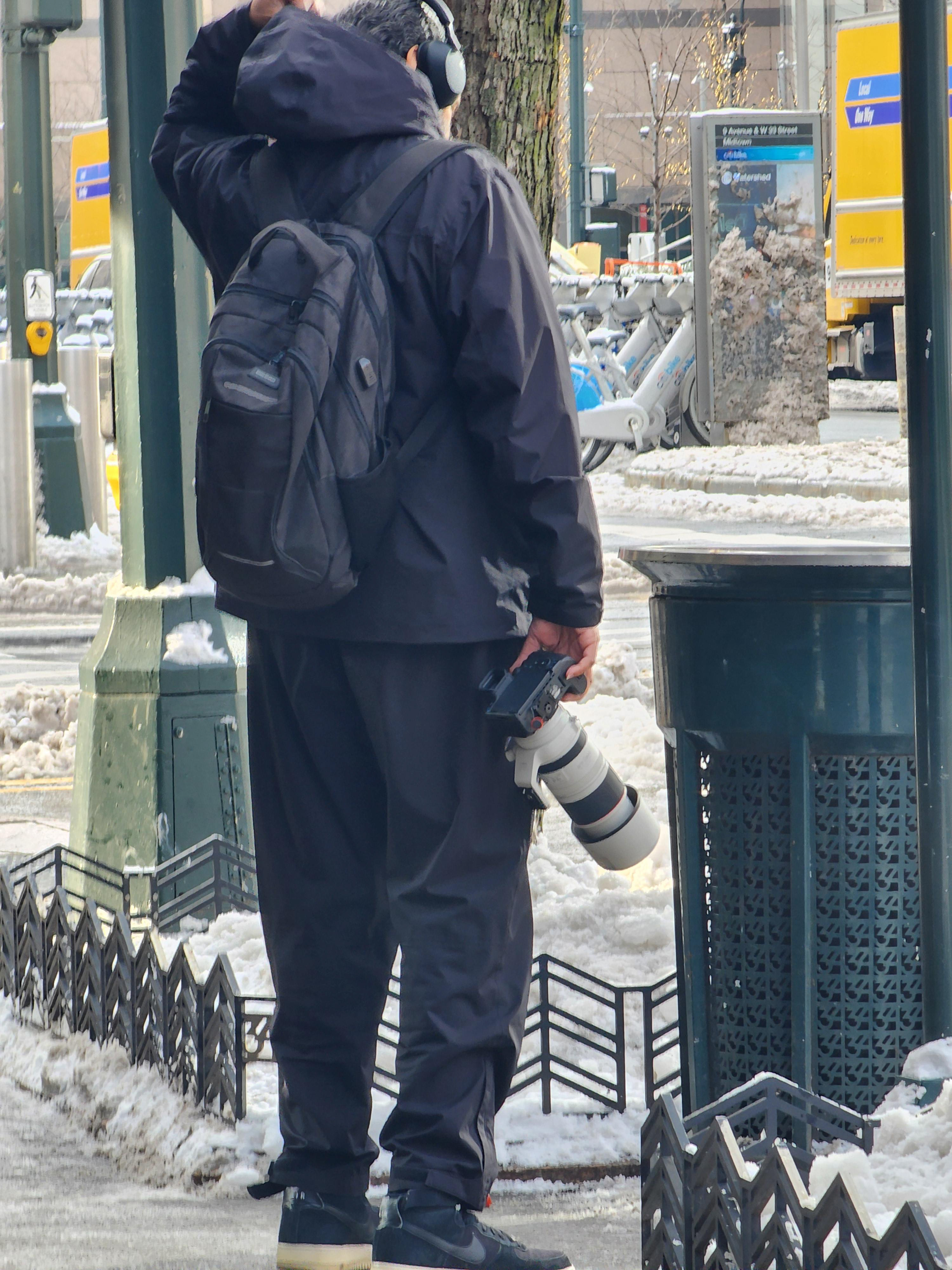
The man in the photo stands half-turned to the street, winter light flattening everything into muted greys and dirty whites, the snow piled like exhausted foam along the curb. He wears black from head to toe: jacket, backpack, pants, shoes, even the headphones wrapping his head like a cocoon. The city barely notices him. And then, hanging casually from his right hand, breaks the spell—a long white telephoto lens, unmistakable, gleaming slightly even in overcast light, like a bone or a prosthetic limb. It’s a visual shout in a scene otherwise composed of whispers. You can almost feel the contradiction: a photographer trying to disappear while holding the most visible object in the frame.
Canon and Sony didn’t make their premium telelenses white to be stylish, and certainly not to help street photographers blend in. The original reason is brutally practical and almost boring: heat. Long telephoto lenses, especially those with big front elements and complex internal groups, expand and contract with temperature. Black absorbs heat fast, especially under direct sun at sports events, safaris, racetracks, or airfields. White reflects it, keeping the lens optically stable and mechanically predictable. Canon learned this the hard way in the film era, when long black lenses would literally drift out of calibration during outdoor shoots. The white paint became a solution first, a signature later. Sony followed because physics doesn’t care about brand identity.
But then something interesting happened, and it’s the part photographers rarely admit. White lenses turned into status objects. They became a visual shorthand for “professional,” for access, for seriousness. You see a white lens and you assume Olympics, sidelines, accreditation, money. It’s branding so effective that Canon could probably release a refrigerator-sized thermos painted white and photographers would still nod respectfully. Sony, coming late to the pro sports market, copied the color not just for heat management, but for instant legitimacy. White lenses say: I belong here, even when you don’t want to be noticed.
And that’s where your discomfort comes from, and you’re right to feel it. Inconspicuousness is part of the ethic of many kinds of photography—street, documentary, travel, quiet observation. A white telephoto lens breaks that contract instantly. It turns the photographer into a performer, an object of attention, sometimes even suspicion. People notice. Security notices. Subjects stiffen. The lens announces itself before you ever raise it. It’s the opposite of the invisible camera ideal, and in places like cities, that matters more than manufacturers ever admit in their marketing brochures.
Ironically, the man in the photo already solved this visually without realizing it. Everything about him says “background character,” except the lens. If that lens were black, he would dissolve into the winter scene like a shadow between snowbanks. Instead, the lens becomes the subject of the photograph, a white punctuation mark at the end of his silhouette. Many photographers now deliberately wrap white lenses in black tape or neoprene covers, not for protection, but for silence. It’s a quiet rebellion against branding, against being mistaken for something they’re not trying to be. And maybe that’s the real lesson here: the best gear is the gear that lets you disappear, not the gear that announces you’ve arrived.
Related